If you asked most people whether they’d like to be interviewed by artificial intelligence instead of a human, the instinctive answer would probably be “no thanks”.
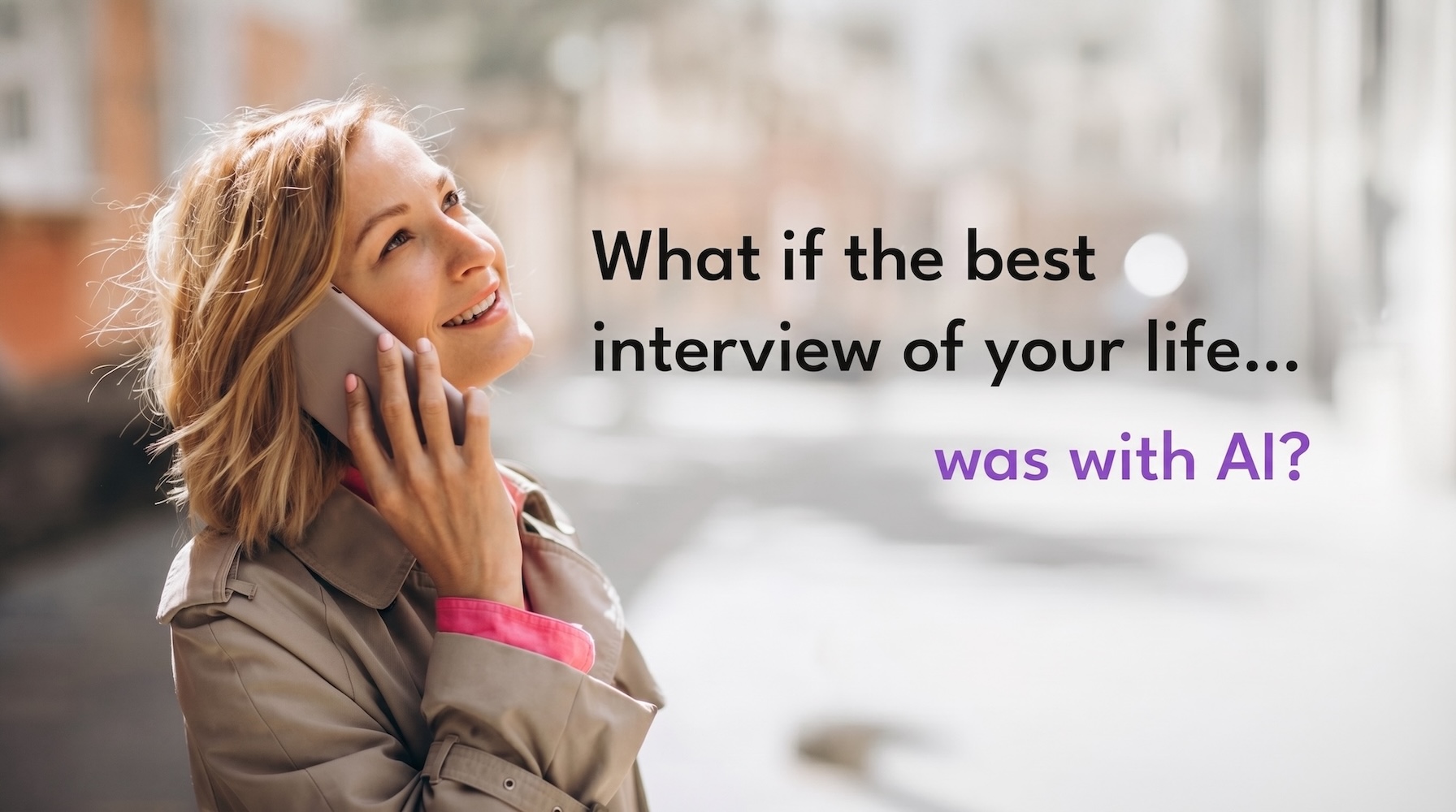
And yet, in a recent experimental study on AI-led interviews, 78% of participants said they preferred being interviewed by AI rather than a human interviewer – when the system was transparent, fair, and clearly explained.
At first glance, this feels counter-intuitive. But if you look at what candidates are actually experiencing in hiring processes today, it starts to make sense.
The real problem isn’t AI. It’s trust.
Globally, candidates are not walking into a neutral, comfortable system:
- Nearly half of job hunters (49%) say they’ve experienced discrimination in a hiring process.
- Around 42% of women report gender-biased or inappropriate questions in interviews, and 41% say they’ve felt discriminated against during an interview.
- Fewer than 2 in 10 candidates rate their overall experience as “excellent”.
Add to this the reality on the employer side:
- Recruiters are managing a growing volume of applications – on average over 2,500 applications per recruiter in 2024, up 106% compared to 2022.
Long and complex processes are pushing candidates to drop out before they even finish an application.
So when candidates say they feel more comfortable with AI in certain situations, they’re not saying “I prefer robots.”
They’re saying: “I’m tired of feeling judged, rushed or dismissed by a process I don’t trust.”
They’re not avoiding humans. They’re avoiding bias, stress and inconsistency.
What the research is starting to show
In controlled experiments where AI voice agents conduct structured interviews, early results are striking:
- A large majority of participants report feeling less judged and more able to be themselves.
- Many say they can think more clearly, because they’re not trying to guess what the interviewer wants.
- Standardised questions and scoring reduce perceived discrimination, especially for candidates who have already experienced bias.
This aligns with a broader trend: as AI becomes more present in HR, 88% of companies globally already use some form of AI in HR, including recruitment.
The difference between “harmful” and “helpful” AI in recruitment is design and governance, not the technology itself.
What we see every day at HooRa with Alex, our voice-based recruiter
At HooRa, we built Alex, our AI-powered voice recruiter, with a very simple rule:
Alex never replaces the human. Alex prepares the human to make better decisions.
Here’s how that looks in practice:
- Interviews designed by HR experts
Every interview script, question and scoring grid is built by seasoned HR professionals – not by a generic language model on autopilot. - Merit-based, bias-aware evaluation
Alex is trained on objective, job-related criteria (behaviours, situations, problem-solving), not on proxies like school, age or “polish”. - Same process for everyone
Every candidate gets the same structure, tone and questions. This alone dramatically reduces inconsistency and “gut-feeling bias”. - Human-validated shortlists
Alex never sends a candidate straight to “hire”. HR teams receive structured insights and voice notes — and humans make the final decision.
The result?
Our candidate Net Promoter Score (NPS) for Alex interviews is consistently around +60 — a level almost unheard of in traditional recruitment processes.
Candidates tell us:
- “I could finally say everything I wanted to say.”
- “I felt less pressure than in a face-to-face interview.”
- “The questions were clear and fair.”
In other words: when the experience is designed with candidates in mind, an AI voice can feel more human than a rushed 15-minute call.
So, will AI reshape the future of recruitment?
We believe it already is.
The question is not “AI or humans?”
The question is:
“Who will succeed in combining data, empathy and expertise in a responsible way?”
At HooRa, our answer is simple:
- Let technology listen without bias.
- Let humans decide with clarity.
And in between, let’s design recruitment processes where candidates finally feel what they’ve been asking for all along: clarity, respect and fairness.


.png)